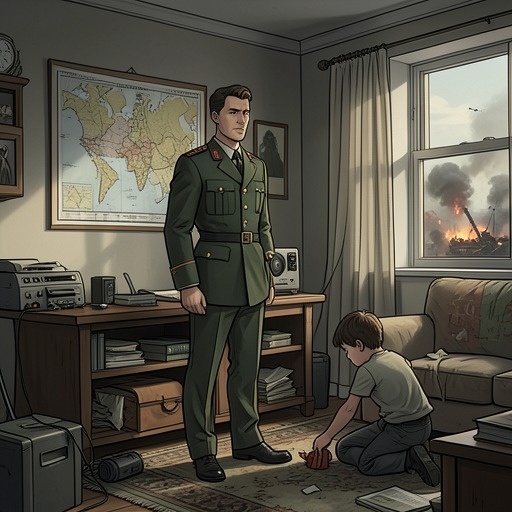
Berlin's first air raid by multiple squadrons
The Zone of InterestThe first multi-squadron air raid on the Nazi power center Berlin ended the capital’s uneasy reprieve and made the war’s violence immediate at the regime’s center. Angelus Thomsen experiences the attack from a hotel wine cellar: first with languid disbelief, then with the sudden awareness that the city itself may be about to collapse around him. By morning, the damage has made the war’s return visible in shattered streets, mass casualties, and the absence of young men.
Background and Approach
Compared with Cologne, Hamburg, Bremen, Munich, Mainz, and the Ruhrgebiet, Berlin had remained largely intact. There had been nuisance raids in late 1940 and early 1941, followed by a lull and no raids at all in 1942. Yet the prospect of a major attack had become a certainty in the public mind: the sky, people knew, would soon be black with planes.
The raid followed the Day of the Luftwaffe, with its parades, march pasts, and grand ceremonies. On the night of March 1–2, sirens woke Thomsen with three sustained chords and a rising howl. He put on his dressing gown without haste and joined a drinks party in the wine cellars of Hotel Eden. The measured, almost indulgent response of the guests made the abrupt change that followed all the more stark.
The Bombardment
After ninety minutes, the party’s levity vanished. Thomsen describes the approaching assault as a blind, stumbling giant straddling whole blocks, each step accompanied by a prehistoric thunderclap. The image turns the unseen attack into something immense and bodily: a force moving through the city with no apparent concern for the people beneath it. As those in the cellar wondered whether they would be atomised, scorched, crushed, smothered, or drowned, the imagined giant suddenly veered east and crashed away.
The reprieve was narrow and did not lessen the destruction beyond the cellar. The account gives a toll of hundreds dead, thousands injured, and perhaps a hundred thousand left homeless. The streets were covered with crackling glass beneath a fume-laden, sulphur-yellow sky. The attack’s scale transformed an approaching threat into a present fact: the war was coming home to the place where it had started, as far as the Wilhelmstrasse.
The City Afterward
The damage was not only visible in the wreckage. After half an hour in the streets, the absence of young men became unmistakable. Bowed work crews from subjugated lands moved in lightly guarded groups, alongside municipal police and SS; otherwise, young men were nowhere to be seen. Those who were present often had crutches or rode in handcarts and rickshaws. At the pubs around Potsdamer Platz, empty sleeves, empty trouser legs, and smashed faces made the accumulated bodily cost of the war impossible to overlook. Even hotel corridors offered a grimly ordinary image of injury: jackboots left out for a shoeshine, their owners’ amputated limbs suggested by the footwear alone.
Significance
The raid reverses the direction of the war’s violence in the narrative. The city that had stood at the origin of the conflict now experiences destruction on its own streets, while the wreckage and wounded bodies make the consequences legible to its inhabitants. Thomsen’s initial lack of urgency in the cellar gives way to a spectacle that cannot be kept at a distance: not an abstract military setback, but glass underfoot, a poisoned sky, the homeless, and a generation of young men missing or maimed.
The scene also places the capital’s suffering beside the much larger violence imposed by the regime. Its destruction is real, but it does not erase the atrocities carried out under Nazi power or make the experiences equivalent. The raid’s decisive change is that war has reached the political center in a form its residents can no longer treat as remote; its aftermath reveals a city already marked by violence even before the attack began.